Why You're Not Getting Stronger at the Table (And How to Fix It)
2026-06-15 · 2 min read
You're training, you're pulling, you're sore — but you're not actually getting stronger at the table. It's one of the most common frustrations in armwrestling, and the causes are almost always fixable once you can see them. Here's what's really going on.
Reason 1 — You're not progressively overloading
Pulling hard isn't the same as progressing. If your wrist curls, holds, and table work stay at the same weight and reps month after month, your body has no reason to adapt. Progressive overload — gradually doing more — is the engine of strength, and it requires you to know what you did last time.
Reason 2 — You're overtraining the same thing
Armwrestlers love to pull. But hammering the same flexion-heavy work every session, with no variation and no recovery, leads to stalls and elbow pain instead of gains. Strength is built in recovery — if you never deload, you never adapt.
Reason 3 — You're neglecting weak links
A chain breaks at its weakest link. If your toproll keeps failing, the problem might be pronation or grip, not "pulling harder." Most plateaus are an under-trained specific quality — and you can't fix what you haven't identified. (Map your game with the key movements.)
Reason 4 — You're not tracking, so you're guessing
This is the big one. Without a record, every other problem is invisible:
- You can't tell if you're progressively overloading.
- You can't see that you've done flexion 9 sessions straight with no extension.
- You can't spot that your left arm hasn't moved in two months.
- You can't tell a real plateau from a bad week.
Memory is a terrible logbook. "I think I'm getting stronger" is how people spin their wheels for a year.
Track your armwrestling training with ArmProgress — log it, see the trend, get stronger.


The fix: track, then adjust
- Log every session — table work and gym lifts, weight and reps, which arm.
- Review the trend every few weeks. Is the line going up? Which lifts are stuck?
- Attack the weak link you find — more pronation, more extension, a deload, or balancing both arms.
- Progress deliberately — beat last time by a rep or a little load. (This is the backbone of any good armwrestling plan.)
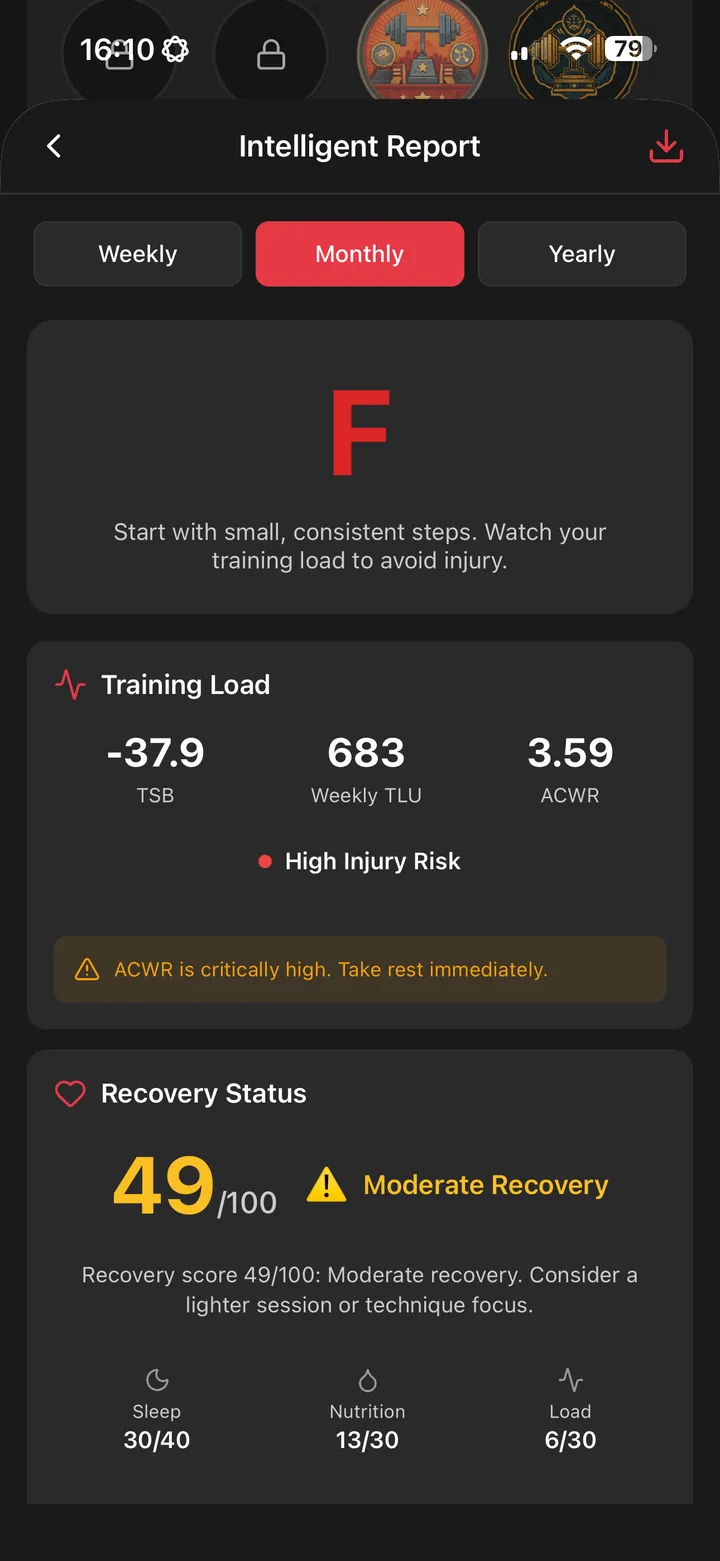
ArmProgress is built around this loop: log table and gym work, track left vs right, and its analytics surface exactly where you're stalling — so "I think I'm progressing" becomes "I can see I'm progressing."
The takeaway
Plateaus aren't a sign you've maxed out — they're a sign something specific is under-trained, over-trained, or untracked. Log your training, read the trend, fix the weak link, and progress on purpose. The pullers who keep getting stronger aren't guessing — they're tracking.
Frequently asked questions
Why am I not getting stronger at armwrestling?
Usually one of four reasons: you're not progressively overloading, you're overtraining the same movement without recovery, you're neglecting a weak link like pronation or grip, or you're not tracking your training so the problem stays invisible.
How do I break an armwrestling plateau?
Log your sessions, review the trend every few weeks, identify the specific stalled lift or weak quality, then attack it — more of the neglected movement, a deload, or balancing both arms — and progress deliberately by beating your last numbers.
Is overtraining common in armwrestling?
Yes. Pullers tend to hammer flexion-heavy work every session with little recovery or extension work, which causes stalls and elbow pain. Strength is built during recovery, so deloads and variation matter.
Why should I track my armwrestling training?
Without a record you're guessing — you can't confirm progressive overload, spot imbalances, notice a lagging arm, or tell a real plateau from a bad week. Tracking makes the fixable problems visible.
Train like an armwrestler
ArmProgress is the training tracker built for armwrestling — log table time and gym work, track left/right, watch your numbers climb, and get AI-powered insights.