Left vs Right: Why Armwrestlers Must Train Both Arms
2026-06-14 · 2 min read
Almost every armwrestler has a "good arm" — and a neglected one. They pull, train, and obsess over their dominant side while the other lags further and further behind. That's a mistake, for reasons that go well beyond competition. Here's why both arms deserve the work.
Why your off-arm matters
1. Competition: you may pull both
Many competitors enter both right- and left-handed brackets. An untrained off-arm is a wasted opportunity — and a fast loss against someone who trained both.
2. Strength carryover and balance
Training both arms builds more total strength and a more balanced, resilient upper body. Lopsided development stresses your spine, shoulders, and posture over time.
3. Injury prevention
A big strength asymmetry is a risk factor. The weaker side's tendons and joints are less prepared, and big imbalances change how you brace and pull. Armwrestling already stresses the elbow heavily — a weak, neglected arm is more injury-prone when it does get loaded.
4. Technique lags badly on the off-arm
Strength isn't the only thing that's one-sided. Your technique on the off-arm is often years behind because you never drill it. (Review the key movements and practice them both sides.)
How to train both arms (without doubling your time)
You don't need two full programs. A few principles:
- Mirror your main work. For your core table and forearm exercises, do the off-arm too — even at lighter loads to start.
- Bring up the weak side first. Start sessions with the off-arm when you're fresh, and give it an extra set if it's badly behind.
- Train unilaterally. Single-arm wrist curls, pronation, and holds let each side work to its own level instead of the strong side carrying the load. (Fold this into your overall plan.)
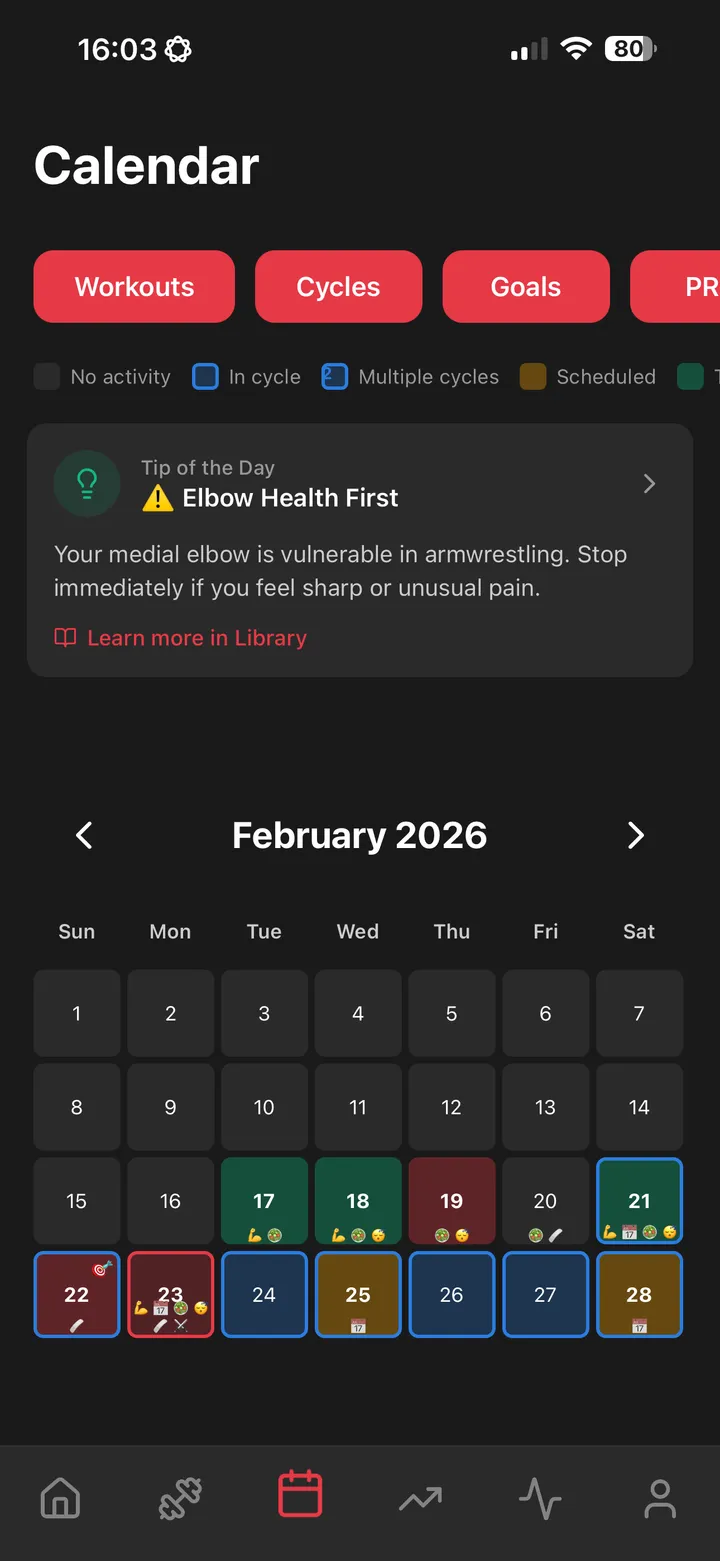
Track your armwrestling training with ArmProgress — log it, see the trend, get stronger.


You can't fix a gap you don't measure
Here's the catch: most people have no idea how big their left-right gap actually is. Was your left wrist curl 5kg behind last month, or 10? Is the gap closing or widening? Without tracking each arm separately, you're guessing — and the weak side stays weak. (It's a classic hidden cause of plateaus.)
ArmProgress tracks left and right separately for every exercise, so you can see the asymmetry, watch it close, and know your off-arm is actually catching up — not just hope it is.
The takeaway
Train both arms: for competition, for balanced strength, for injury prevention, and because your off-arm's technique needs the reps too. Mirror your key work unilaterally, prioritize the weak side, and — crucially — track each arm separately so you can see the gap and close it.
Frequently asked questions
Should armwrestlers train both arms?
Yes. Training both arms supports competing in both brackets, builds balanced total strength, reduces injury risk from asymmetry, and develops technique on the off-arm, which otherwise lags far behind.
How do I train my weaker armwrestling arm?
Mirror your main table and forearm work on the off-arm, start sessions with the weaker side when you're fresh, use single-arm (unilateral) exercises, and give the weak side extra volume until the gap closes.
Is left-right strength asymmetry dangerous?
Large asymmetries raise injury risk because the weaker side's tendons and joints are less prepared and imbalances alter how you brace and pull. Armwrestling already stresses the elbow heavily, so balancing both arms is protective.
How do I track left vs right arm progress?
Log each arm separately for your key exercises so you can measure the gap and whether it's closing. ArmProgress records left and right independently and shows the comparison over time.
Train like an armwrestler
ArmProgress is the training tracker built for armwrestling — log table time and gym work, track left/right, watch your numbers climb, and get AI-powered insights.