Grip & Forearm Strength for Armwrestling: The Exercises That Matter
2026-06-17 · 2 min read
Ask any seasoned puller where matches are won and they'll point at the hand and forearm. You can be strong everywhere else, but if your grip and wrist give out, you lose. Here are the forearm and grip exercises that actually carry over — and how to train them without wrecking your elbows.
Why grip and forearm rule armwrestling
Armwrestling loads the forearm in ways no bench or curl does: you're resisting your opponent's wrist while driving your own, under heavy, awkward angles. The forearm muscles controlling wrist flexion (cupping), pronation, and finger grip are the front line. Build those and your whole game improves.
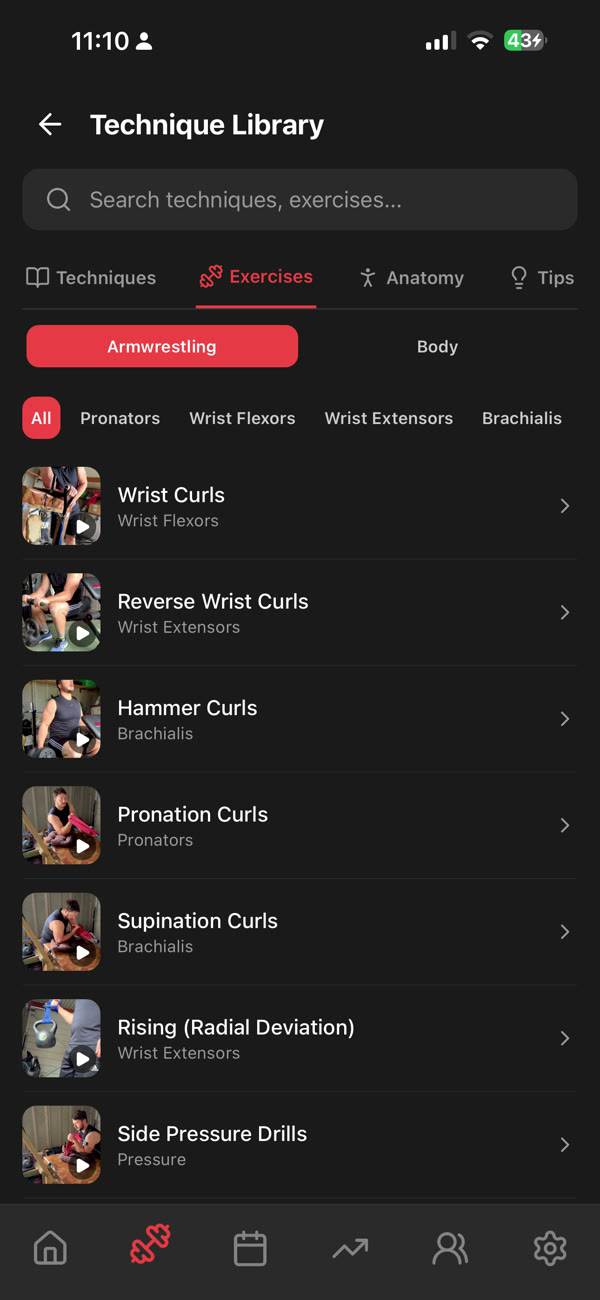
The exercises that carry over
Cupping / wrist flexion
The king of armwrestling forearm work. Cup a handle or dumbbell, flexing the wrist toward you under control.
- Wrist curls (barbell/dumbbell) — 3×8–12
- Cupping with a handle + strap/weight — 3×8–12
Pronation
Turning the hand over — the engine of the toproll.
- Pronation with a pronator bar or off-set dumbbell — 3×10–12
- Band pronation — 2–3×15
Grip (crush + support)
- Thick-bar or towel support holds — 3×20–30s
- Heavy farmer holds — 3×30s
- Hand-gripper work (crush) — 3×submax
Finger & wrist posterior (balance + health)
- Reverse wrist curls / wrist extension — 2–3×15 (keeps the elbow healthy)
- Rice bucket work — 2–3 min (great for recovery and tendon health)
How to program it without frying your tendons
The forearm tendons and the medial elbow take a beating in armwrestling. Two rules:
- Build volume gradually. Forearms can handle frequency, but the connective tissue needs time. Add load slowly.
- Balance pulling with extension work. Most pullers overtrain flexion and undertrain extension, inviting elbow pain. Include reverse wrist curls and rice-bucket work.
Track your armwrestling training with ArmProgress — log it, see the trend, get stronger.


A sensible weekly dose: 2–3 forearm/grip sessions, mixing one heavy day and one higher-rep "health" day. Pair it with your table and gym training plan, and don't neglect the specific table movements where this strength gets expressed.
The takeaway
If you only had time to train one region for armwrestling, it'd be the forearm and hand. Prioritize cupping, pronation, and heavy grip, balance it with extension work for healthy elbows, and build the load gradually. Track your wrist-curl and hold numbers over time — that climbing line is your carryover to the table.
ArmProgress lets you log every wrist curl, hold, and pronation set, and see the trend — so you know your grip is actually getting stronger, not just sore.
Frequently asked questions
What are the best forearm exercises for armwrestling?
Cupping/wrist curls, pronation work, heavy support and thick-bar holds, and reverse wrist curls for balance. These train the wrist flexion, pronation and grip that armwrestling depends on.
How often should I train grip for armwrestling?
About 2–3 sessions a week works for most, mixing a heavy day with a higher-rep health day. Build volume gradually because the tendons and medial elbow adapt slower than the muscles.
Why do my elbows hurt from armwrestling training?
Usually from overtraining wrist flexion and table pulls without balancing extension work, plus ramping load too fast. Add reverse wrist curls and rice-bucket work, and progress slowly.
Is grip strength enough to win at armwrestling?
Grip is essential but not sufficient — you also need pronation, side pressure, biceps strength and technique. Grip and forearm strength are the foundation the rest is built on.
Train like an armwrestler
ArmProgress is the training tracker built for armwrestling — log table time and gym work, track left/right, watch your numbers climb, and get AI-powered insights.